
- How to Display Tax-Inclusive Prices in LatePoint
- Bundled Services
- Managing Bookings With The New Shopping Cart
- Set custom start date for the calendar on your booking form
- How to make Phone Number a required field?
- How to Show Only Services or Only Bundles in a Booking Form
- How to Set Base Fee for Group Bookings
- How to Show Custom Display Price for Bundles
- Add booking form directly on a page
- Redirect to a custom “Thank you” page after booking is complete.
- Add custom content before or after booking steps
- Customize Book Button Appearance
- Add preselected Agent, Service or Location on Book Appointment Button or Form
- How to change time slot style on the calendar?
- Custom CSS for changing colors
- Booking Form Editor
- Specify which services, agents and locations will be available on a booking form
- How to pick specific categories to be displayed on the booking form
- How to show only services from specific category
- Set custom fonts for the booking form
- How to setup Facebook Pixel
- How to Disable the Messaging Functionality in LatePoint
- How to upgrade to Version 5?
- How to Update to Version 5.1.0
- Which addons are part of a PRO bundle in version 5?
- How to deactivate my license from a website I no longer use.
- Redirect to a custom “Thank you” page after booking is complete.
- How to add a link to terms of service checkbox custom field
- Edit content of the left panel section
- How to enable self hosted Google Calendar setup?
- How does LatePoint send emails?
- How to enable debug log?
- Add to Calendar link is not working
- Getting “One of the plugins is invalid” error when installing add-ons
- Error: unexpected ‘int’, expecting function…
- Service categories not showing during booking process
- Error: Cannot read properties of null (reading: verifyBuyer)
- WordPress Users still can’t login, even when “Use WordPress users as customers” option is checked
- New service is being created when trying to update existing service.
- Auto-sync of events from Google Calendar is not working
- Understanding limitations of Google App user type
- Data missing after update or your license key is not working
- I am getting “Invalid Request” error when creating or updating records
- LatePoint can not reach my website when setting up Google Calendar or Stripe Connect
- Prevent Agents being redirected to WooCommerce “My Account” Page when trying to login to LatePoint Agent Account
- When customers try login in to Customer Dashboard they are re-directed to the same login page again
- Google Calendar Connect shows app is not verified message
- Google Authorization Error. Clicking Connect Button on Google Calendar not working
- How to fix Verification Error on the LatePoint Booking Form
- How to Fix the “Error: Email Address Has to Be Unique” While Creating Appointments via Admin UI
- How to Roll Back to a Previous Version of LatePoint
- Load LatePoint Front-End Scripts Only on Specific Pages
- How to Fix “The selected payment method is not available. Please choose a valid payment method and try again.”
- How to Fix “Stripe Connect Account ID Not Set” Error
Understanding limitations of Google App user type
When you create a Google App that is used to connect your agent’s calendars – you have two options for it’s user type: External or Internal. You can always change the user type of your application by going to OAuth consent screen in your Google project.
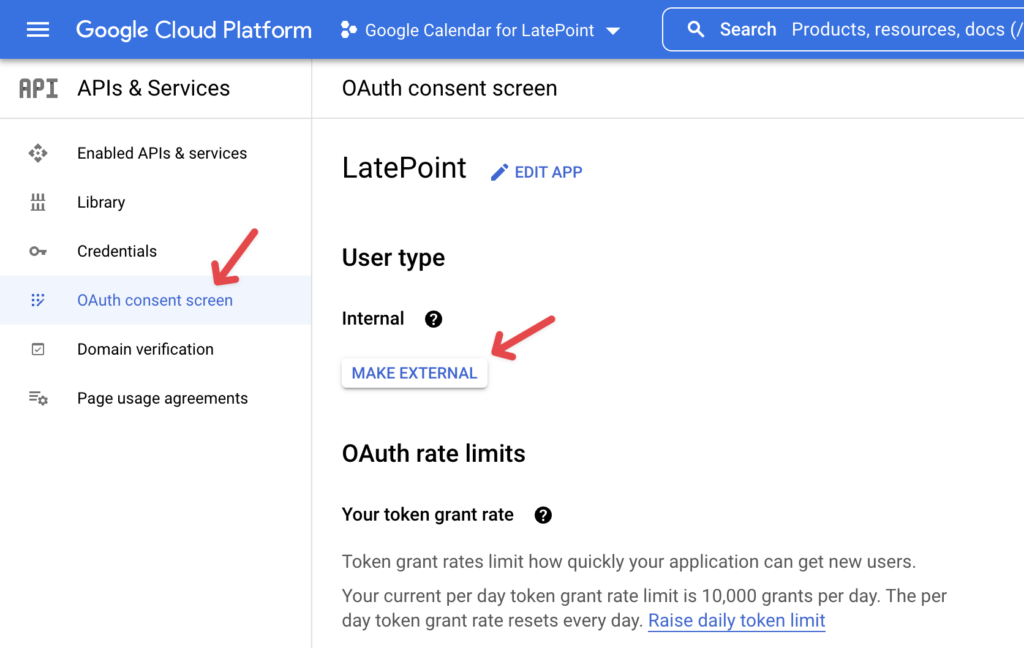
Depending on user type you set – following limitations will be applied by Google.
External
Projects configured with a user type of External are available to any user with a Google Account.
A user’s ability to authorize your app’s requested scopes are impacted by your project’s publishing status.
Testing
- Projects configured with a publishing status of Testing are limited to up to 100 test users listed in the OAuth consent screen.
- Authorizations by a test user will expire seven days from the time of consent. If your OAuth client requests an
offlineaccess type and receives a refresh token, that token will also expire. - Google will display a warning message before allowing a specified test user to authorize scopes requested by your project’s OAuth clients. The warning message confirms the user has test access to your project but should consider the risks associated with granting access to their data to an unverified app.
In Production
- Projects configured with a publishing status of In production are available to any user with a Google Account. A project’s publishing status is considered In production after selecting the Publish app button. Your project’s configuration may be subject to verification before its name and logo are displayed on an authorization screen or before it may request authorization of sensitive or restricted scopes.
- Projects configured with a publishing status of In production should complete the verification process, including defining scopes actively requested by your project’s OAuth clients, if it meets one or more of the OAuth verification criteria, as described in Verification status.
- Google will display an Unverified apps warning message if your project’s OAuth clients request authorization of scopes considered sensitive or restricted before your project has completed verification for those scopes.
Internal
Only members of the same organization can use this app. For example you have a Google Workspace account on domain example.com, you’ve used it to create App – then only those users who belong to the same Workspace, for example [email protected] and [email protected] can sync their Google Calendar to your app.
More info on application user types: https://support.google.com/cloud/answer/10311615#user-type&zippy=%2Cinternal%2Ctesting%2Cexternal
We don't respond to the article feedback, we use it to improve our support content.